An AI Tutor That Knows Your Learning Context, Not One Feedback for Everyone
Project Overview
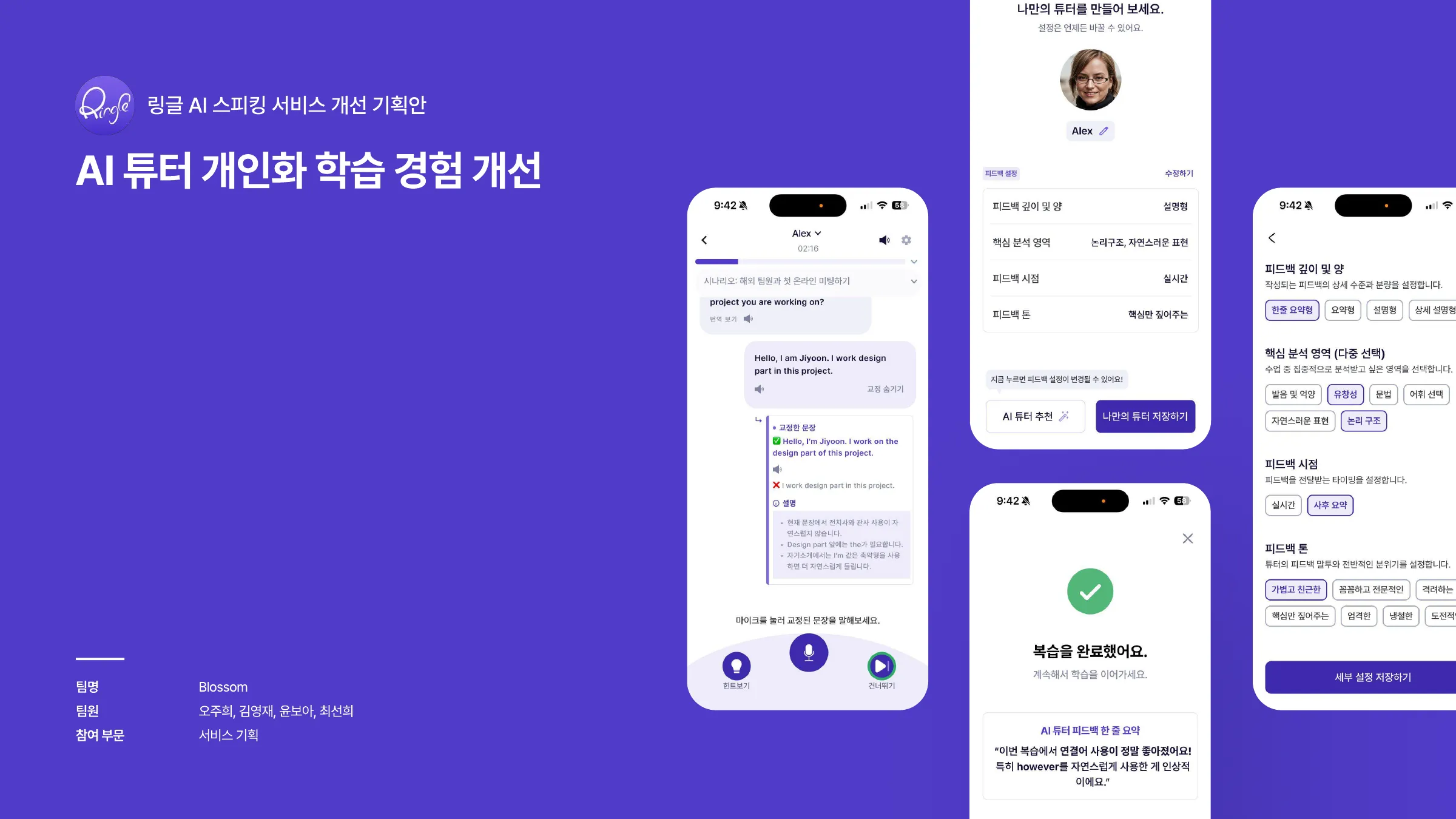
Ringle's AI speaking feedback comes in the same structure for every learner. As team lead, I took the project from research to screen design, planning an experience where learners choose the depth, focus, timing, and tone of feedback and the AI coaches to their context.
View as PDF (Korean)- Project type
- Team Project (Team Lead, 4 people)
- Duration
- 3 Months
- Role
- Team Lead, Research Design, Problem Definition, Screen Design
- Tools
- Figma, FigJam, Google Forms
Background
AI speaking has improved. Why isn't it used as a learning tool?
Is the problem the technology, or the design of the learning experience?
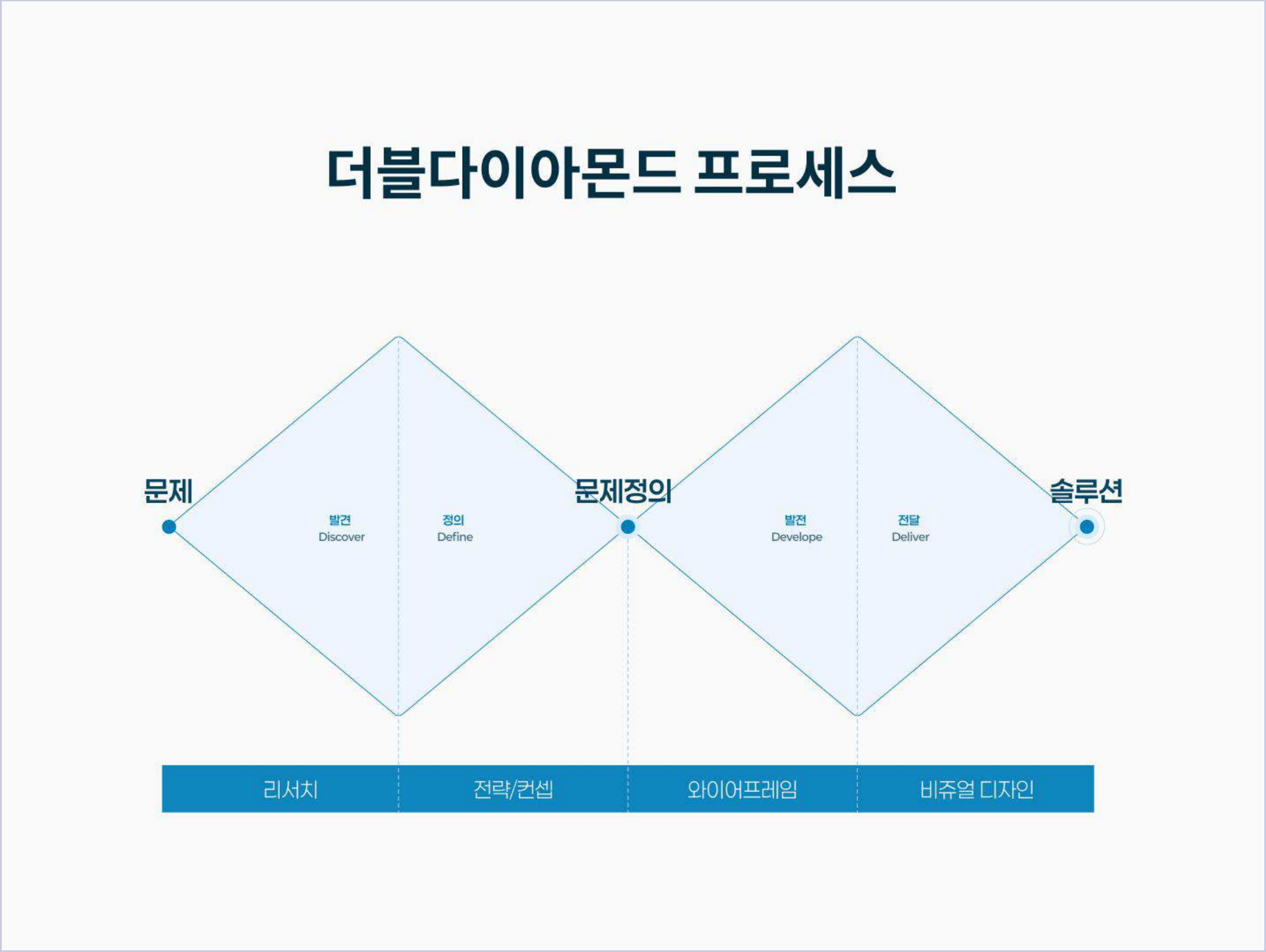
Ringle teaches English through real conversations with native tutors. AI speaking is a chance to bring that experience to more people, but learners were not turning conversations with AI into steady study. This project set out to find out why, and to design personalized feedback that fits each learner’s context. We followed the Double Diamond process throughout. The screens and research materials are in Korean, as the project was done for a Korean service.
Key Features

A tutor the AI recommends and you keep
The AI first suggests a tutor and a feedback style that fit the chosen scenario. Learners can save it as is, ask for another recommendation, or edit it themselves.

Set the depth, focus, timing, and tone of feedback
From a one-line summary to a detailed explanation, from pronunciation to logical structure. Learners adjust how they receive feedback along four axes to match their level and purpose.
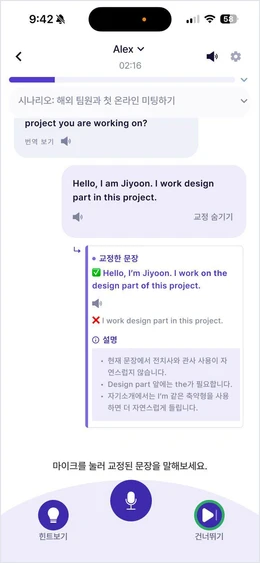
Fix it right after speaking, then say it again
With timing set to real time, the corrected sentence and the reason appear right after each answer. Learners repeat the corrected sentence and finish the practice on the spot.

One line at the end on what got better
When a session or review ends, the AI tutor sums up the key point in one line. Learners see where they improved without reading a long report.
Discover
Why don’t learners use AI speaking well as a learning tool?
Academic Research
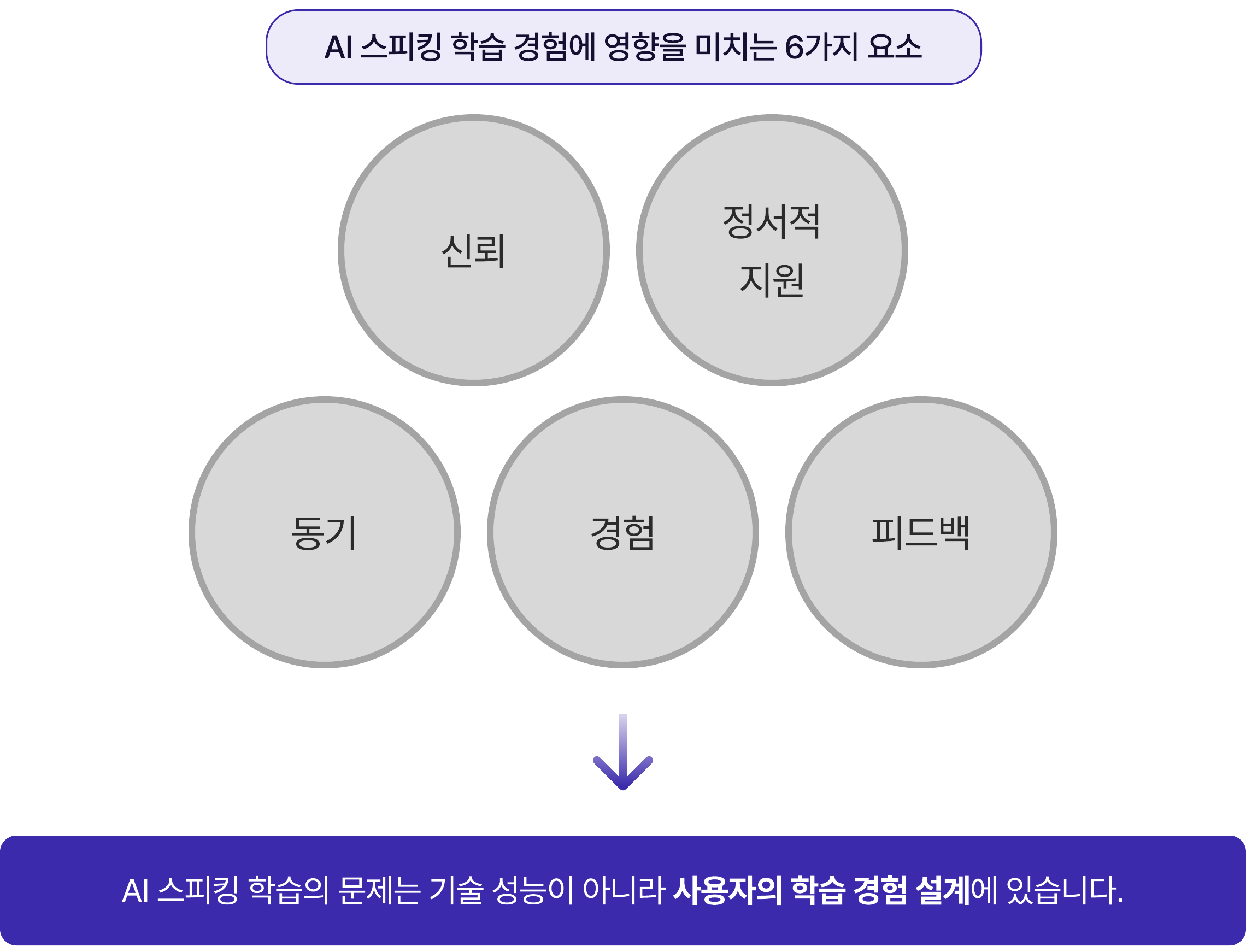
Six factors that shape the learning experience
We analyzed 17 academic studies on AI-based language learning and grouped the key factors into six. What the studies pointed to was not speech recognition or model accuracy. The problem with AI speaking is not technical performance but the design of the learning experience.
SWOT Analysis
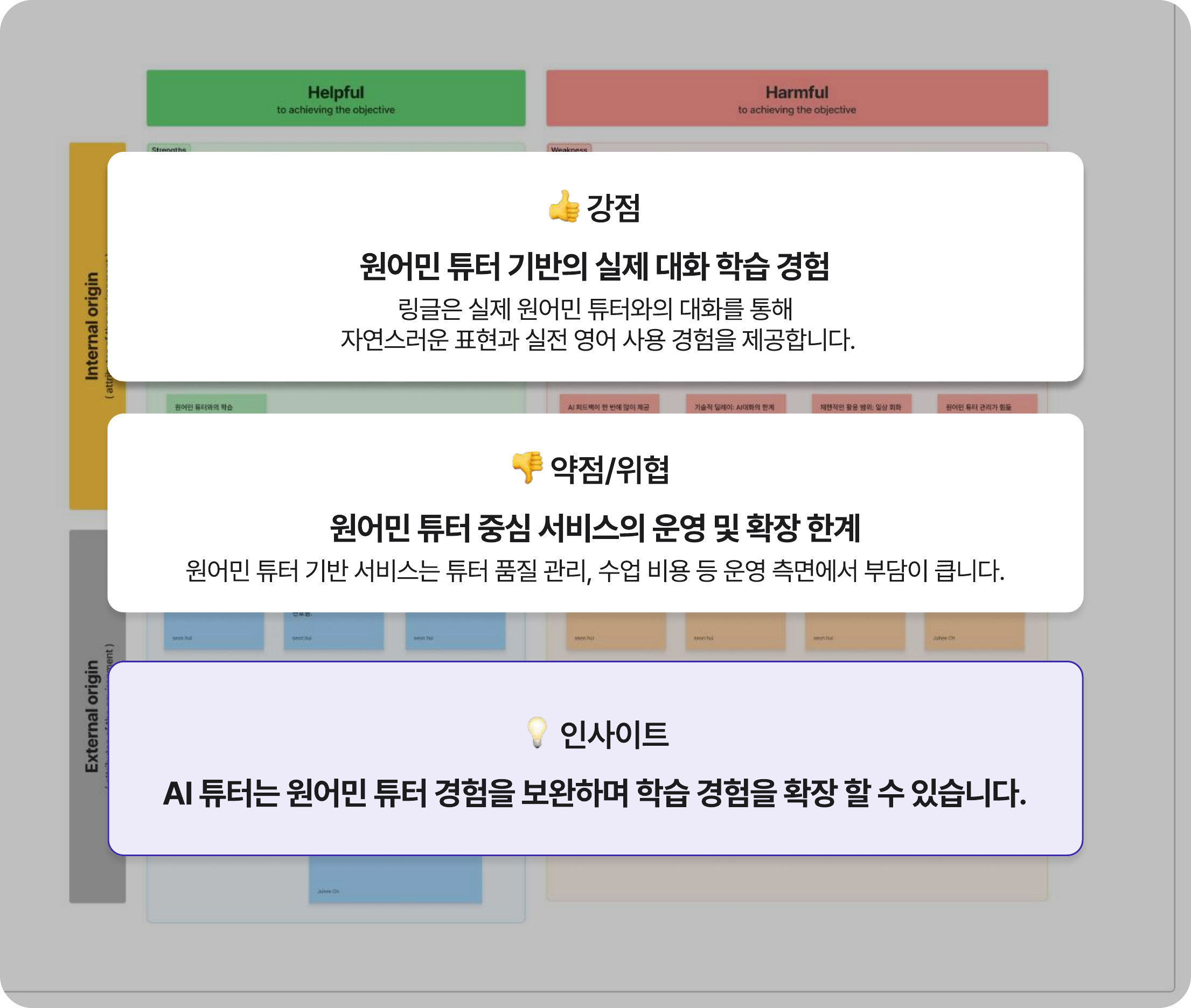
Ringle's core strength and its limit
Ringle’s strength is the natural expressions and real-world practice that come from talking with native tutors. But a tutor-centered service is costly to run and scale, from tutor quality control to lesson cost. We saw the AI tutor not as a replacement but as a way to complement and extend that experience.
Competitor Research
What learning experience do AI speaking services offer?
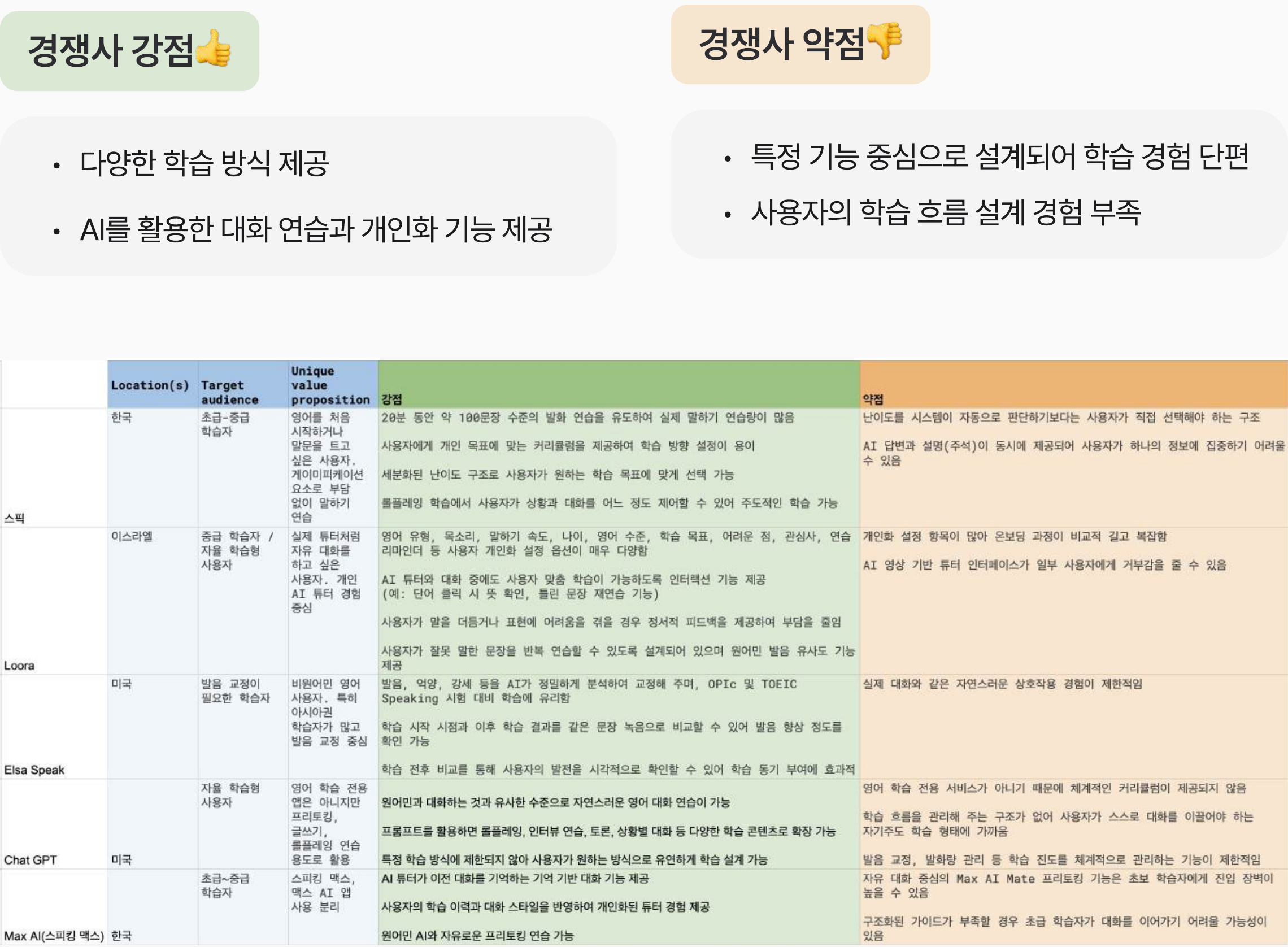
We compared five services in Korea and abroad, Speak, Loora, ELSA Speak, ChatGPT, and Speaking Max AI, by target, core value, strengths, and weaknesses. Most offered varied study modes and AI conversation practice, but they were built around single features, so the experience felt fragmented and little was designed to carry the learner’s flow forward.
Survey
What do learners want most from AI speaking?
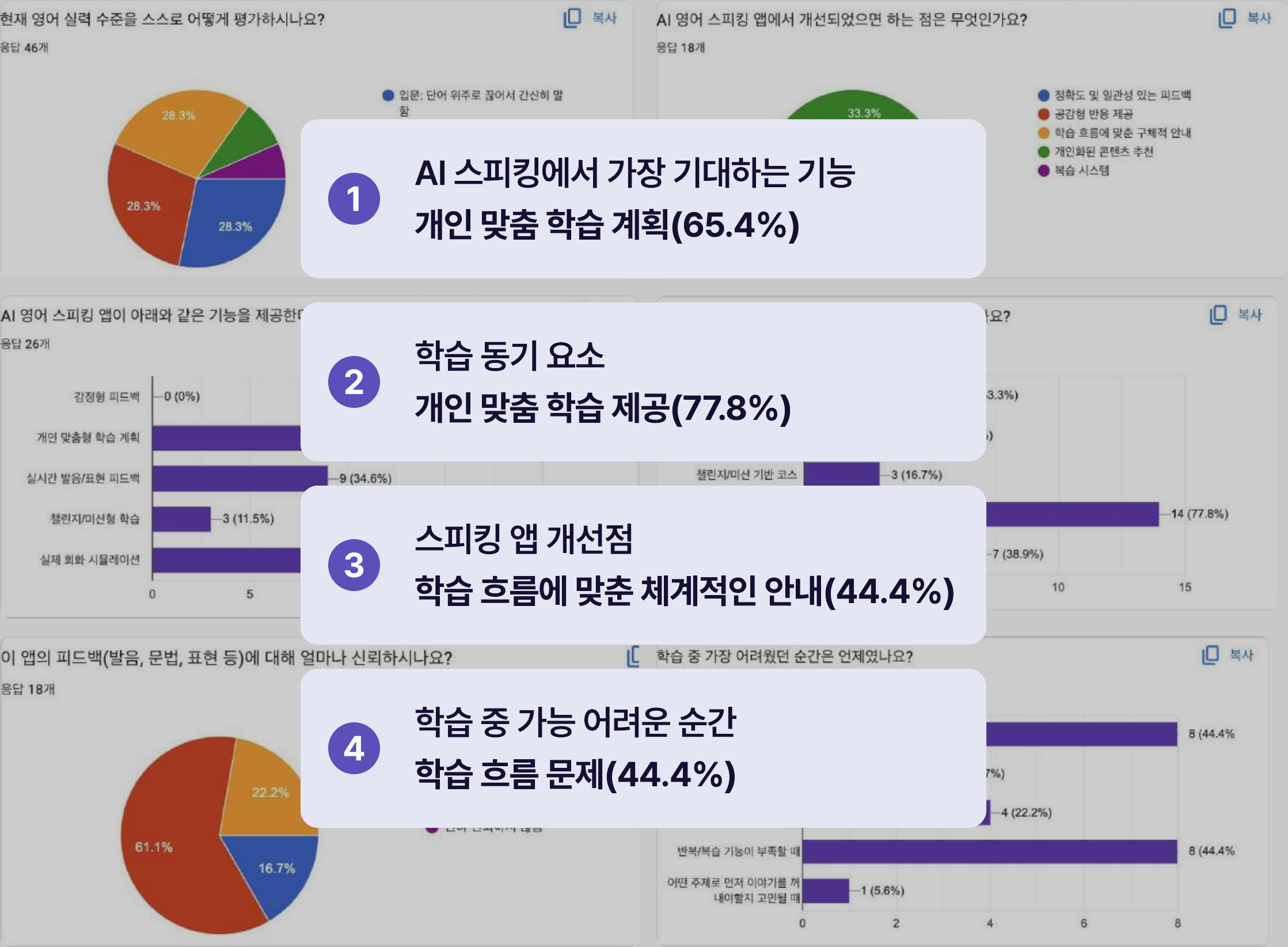
There were already plenty of features. To see which ones learners actually care about, we surveyed 46 people. The most expected feature was a personalized study plan (65.4%), and the strongest motivator was personalized learning (77.8%). Learning flow was named both as the top thing to improve and as the hardest moment while studying (44.4% each).
1:1 In-depth Interviews
The core issue: feedback that isn't personalized
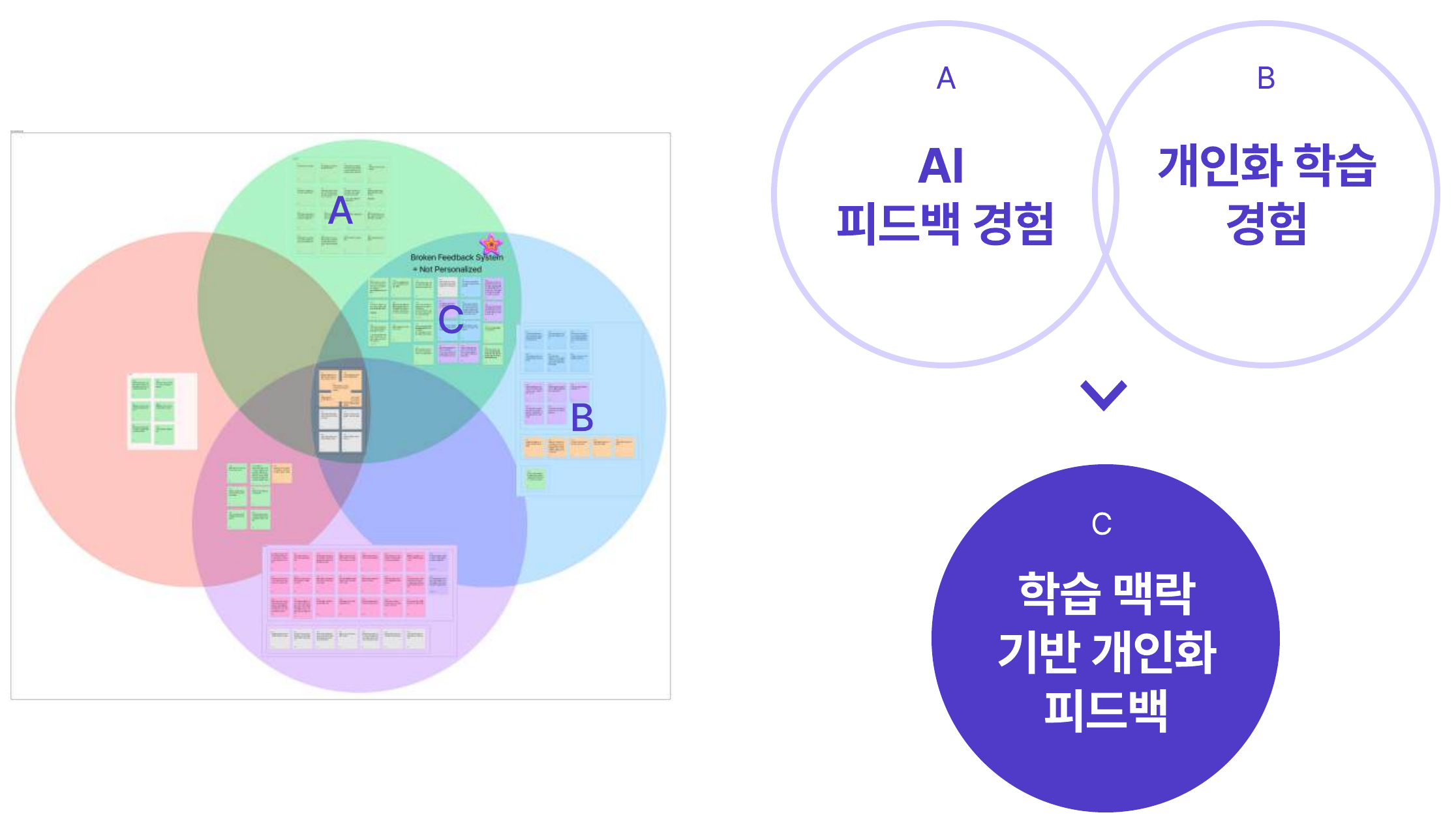
To understand the pattern of personalization and learning flow from the survey, we ran 1:1 in-depth interviews and grouped what people said with affinity mapping. Where two clusters overlapped, AI feedback experience and personalized learning experience, personalized feedback based on learning context emerged as the core problem.
Define: Problem Statement
Learners expect tailored feedback, but today’s feedback is the same for everyone.
Persona
Jieun Kim, a third-year marketer uneasy with business English
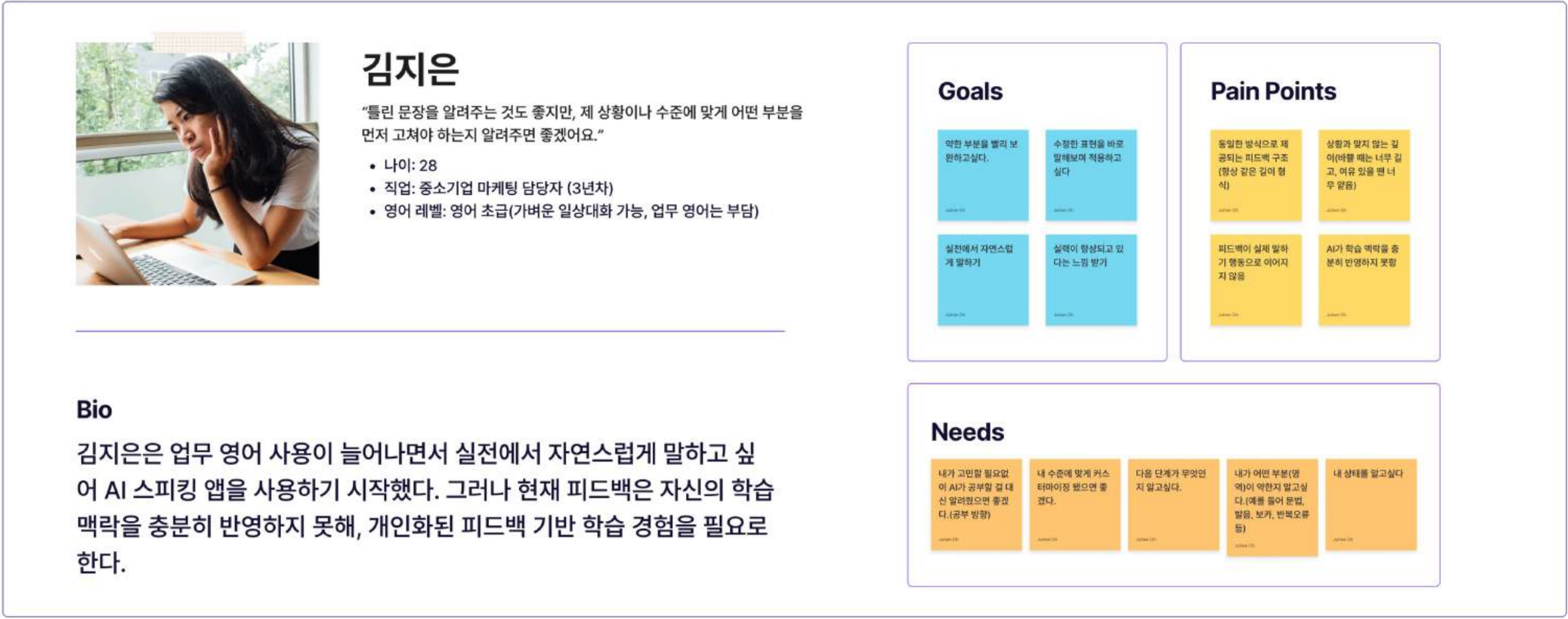
We turned the research into a persona that captures the goals, difficulties, and learning context of an AI speaking learner. Jieun Kim is a 28-year-old marketer who can handle everyday conversation but finds business English a burden. Being told a sentence is wrong is not enough for her. She wants to know what to fix first, given her situation and level.
Develop
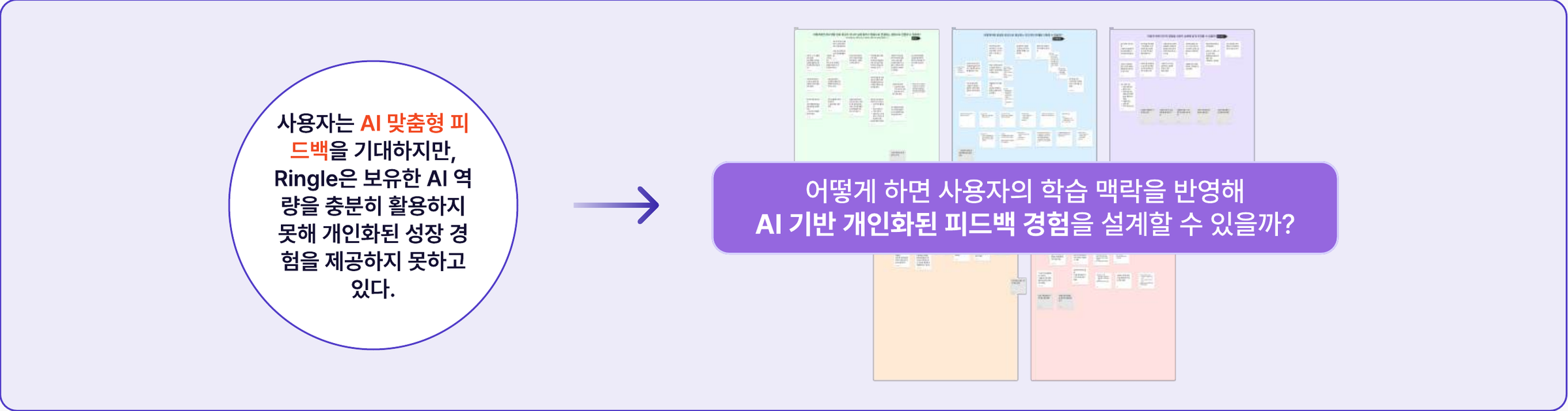
How might we design AI-based personalized feedback that reflects the learner’s context?
Brainstorming
From problem statement to an HMW question
We turned the problem statement into a single How Might We question, and the whole team generated ideas that answer it.
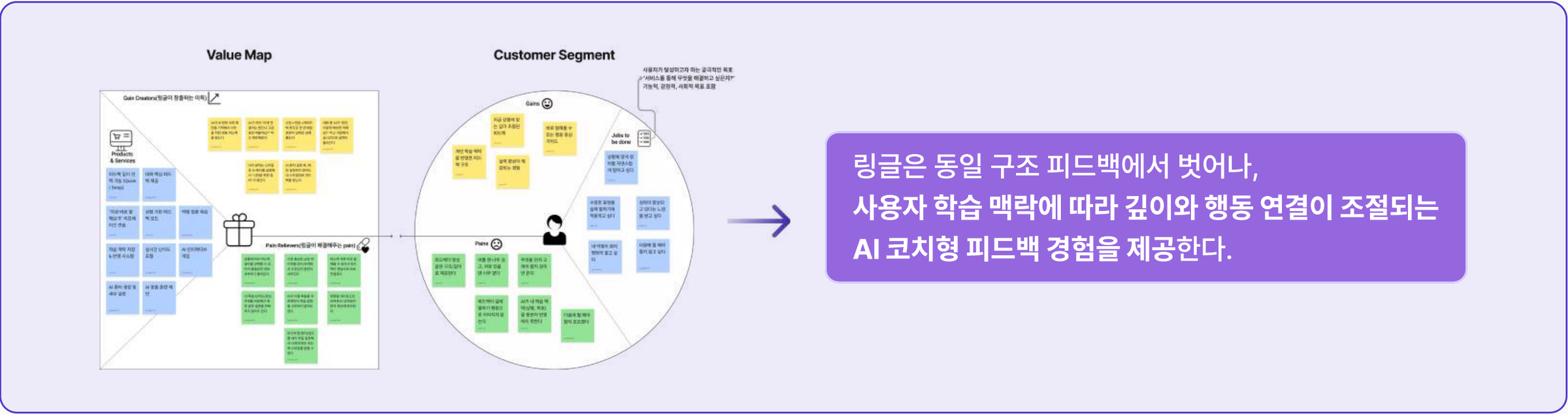
Value Map
From same-structure feedback to AI coaching
We matched learners’ jobs, pains, and gains against the value Ringle can offer and narrowed the direction to one sentence. Ringle moves away from same-structure feedback and offers AI coaching feedback whose depth and link to action adjust to the learner’s context.
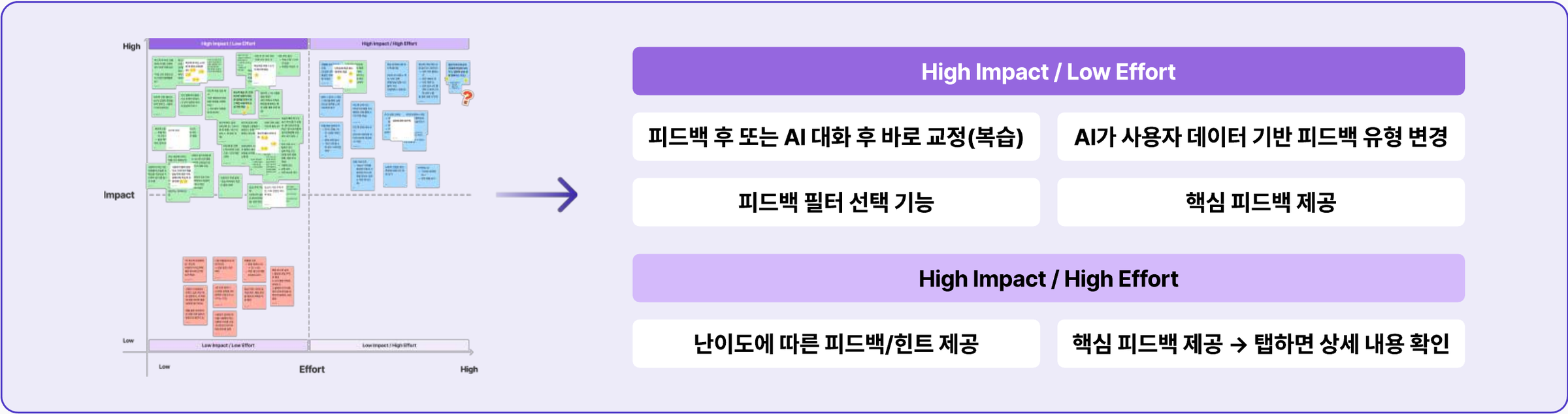
2×2 Prioritization Matrix
High impact, low effort first
We placed the ideas on two axes, impact and effort, to set the MVP scope. We chose to start with correcting and reviewing right after a conversation, feedback types that change with user data, a feedback filter, and key feedback. Level-based hints and tap-to-expand detailed feedback were left for the next phase.
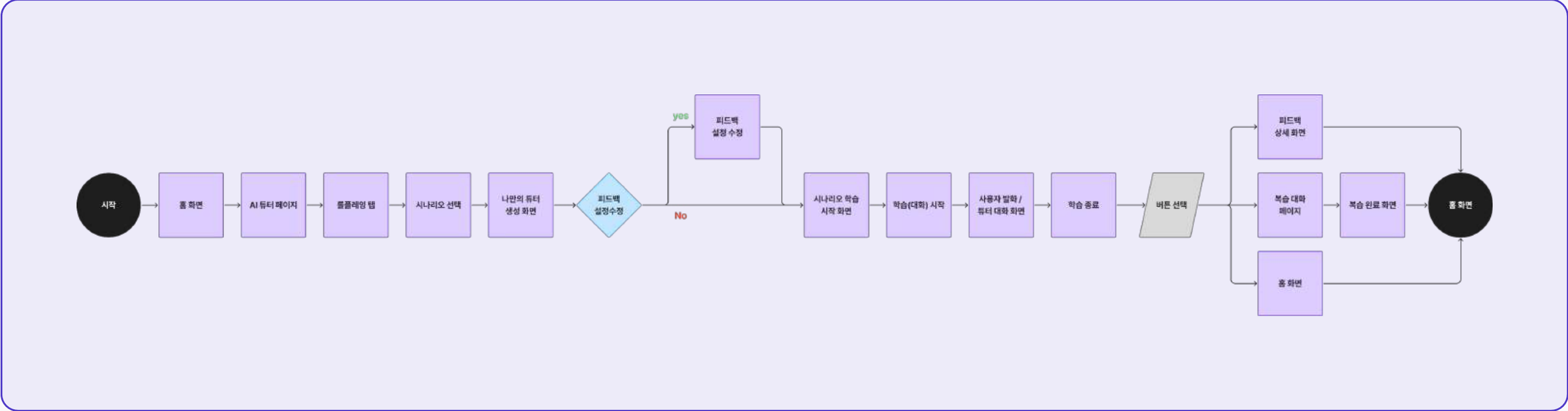
User Flow
Tutor setup, conversation, summary, and review as one flow
Learning flow was the most common complaint in the survey, so we placed feedback settings between choosing a scenario and starting the conversation instead of in a separate menu. After a session, the summary feedback leads straight into review.
Deliver
How does tailored feedback look on screen, and how does it carry on?
Screens 1–4
Setting up the AI tutor and feedback style
Learners use the feedback style the AI recommends or change it themselves to build a feedback setup that fits their current situation.
01. Create AI tutor

02. AI recommendation

03. Detailed settings
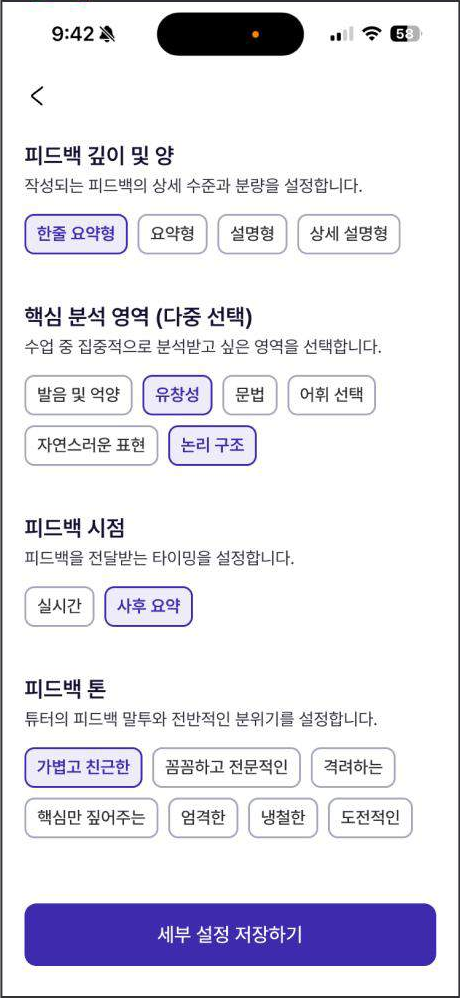
04. Before the conversation

Screens 5–8
Correct while talking, get a summary at the end
The role-play conversation runs in the chosen feedback style. Learners practice on the spot with real-time correction and repeat-after speaking, then check the result in the AI summary.
05. Role-play conversation
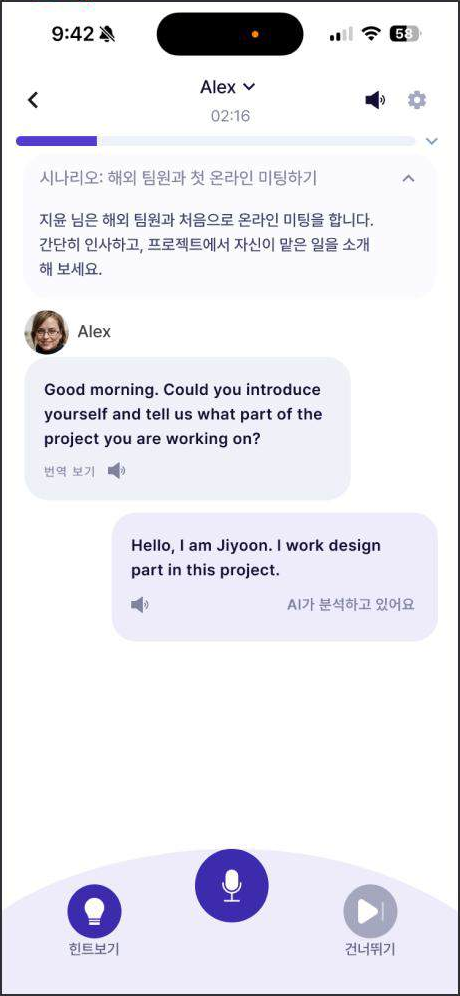
06. Analysis and correction
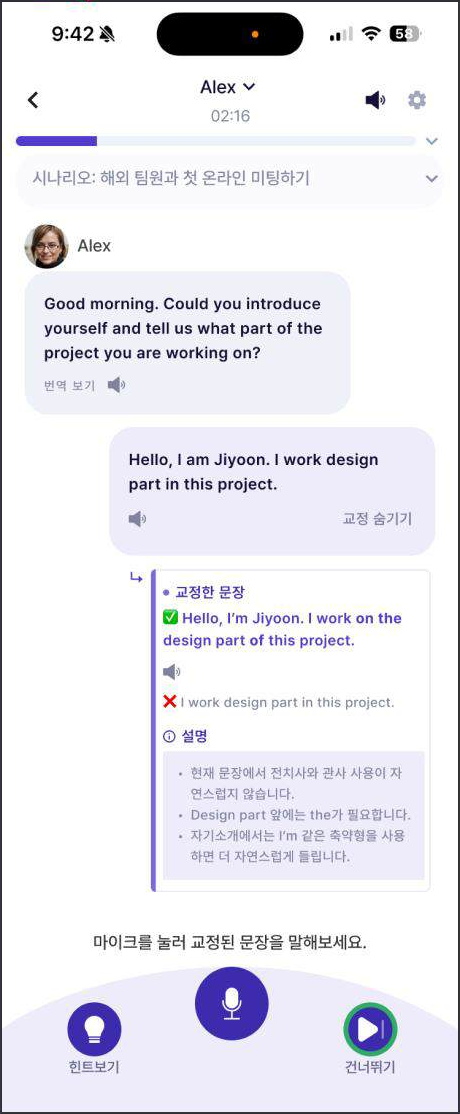
07. Corrected sentence spoken
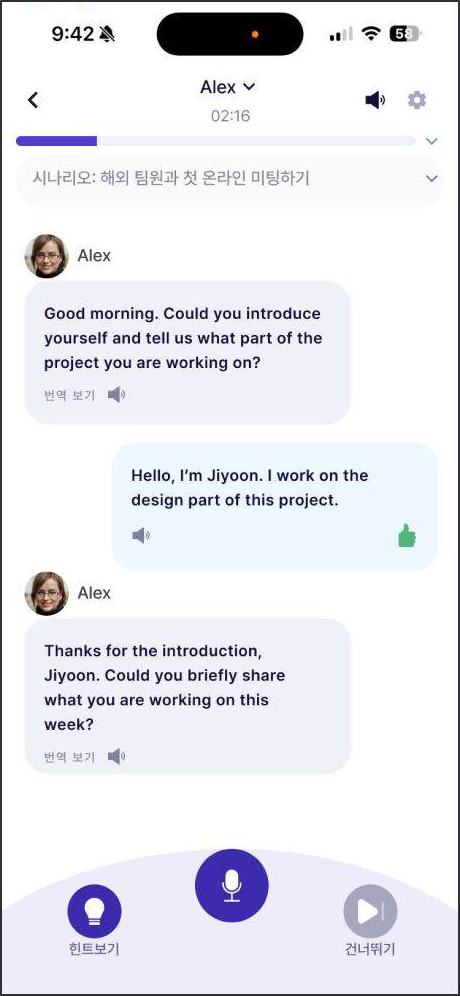
08. Session complete

Screens 9–11
Reviewing and moving to the next level
Learners review by talking through a scenario they studied before. Once they use all the target expressions, the AI judges their level and suggests the next step, then sums up the review in one line.
09. Review in progress
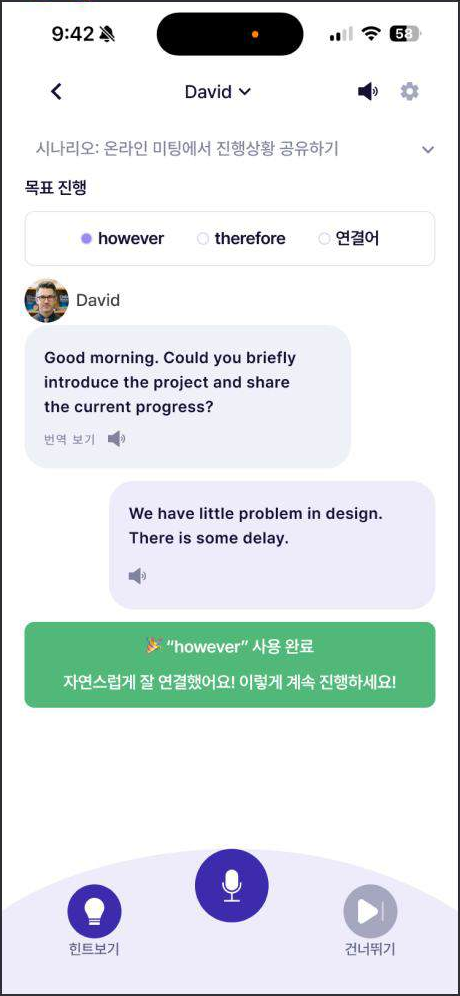
10. Goal reached
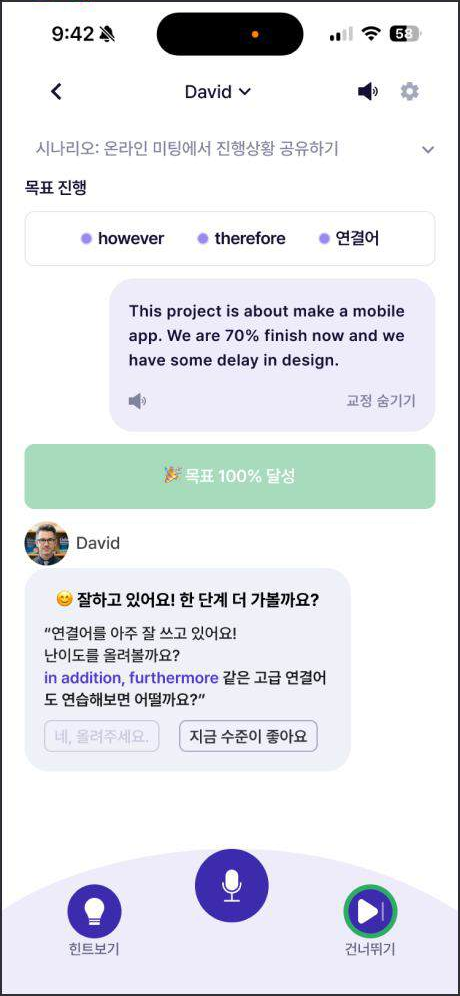
11. Review complete

Final Screens
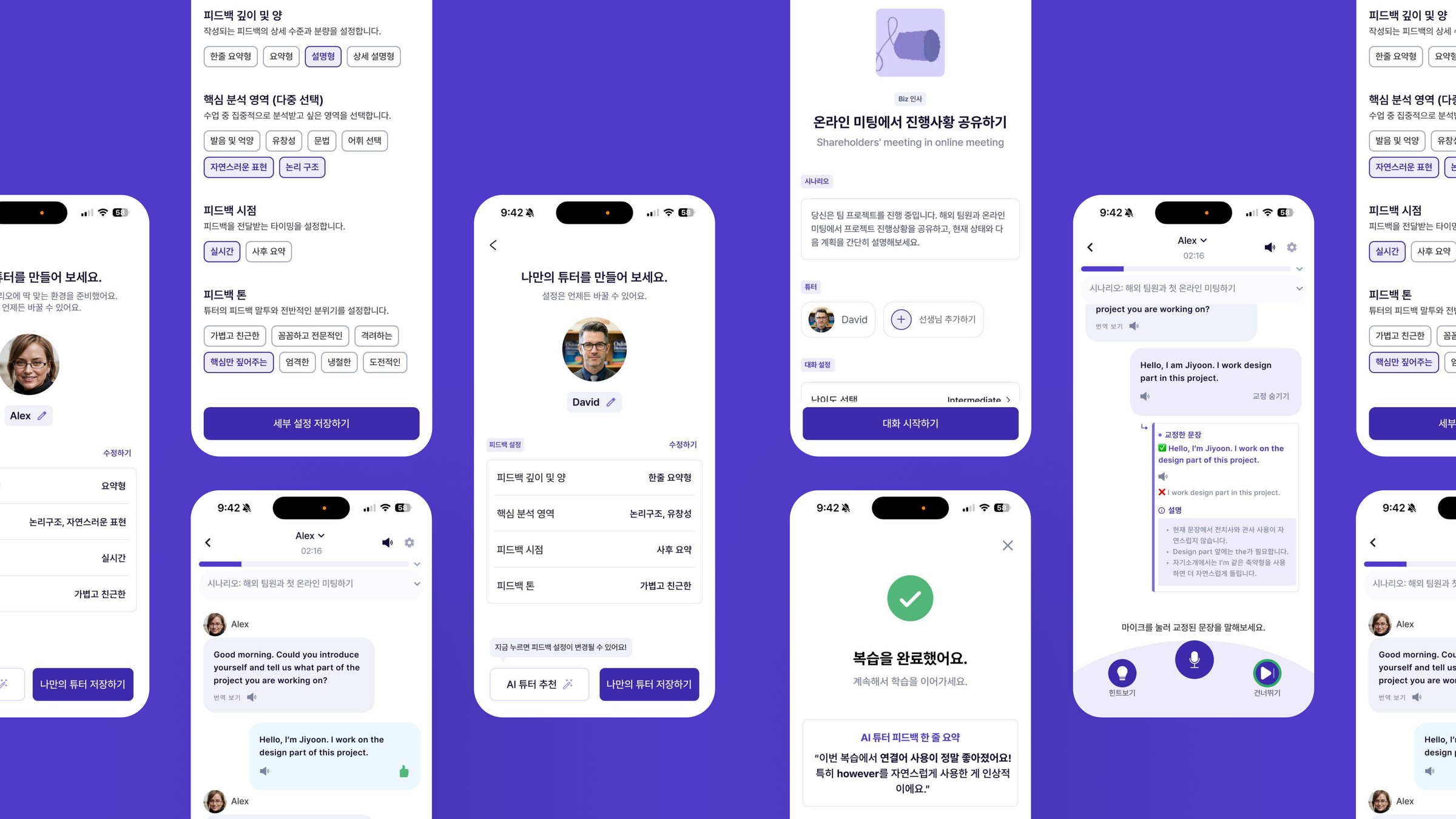
An AI tutor that knows your learning context
Takeaways
What I learned from this project
01Finding the problem in the learning flow, not in features
At first I looked for which feature was missing. But the academic studies, the survey, and the interviews all pointed to the same place. Learners were stopping not because a feature was absent but because feedback did not connect to their own context. I learned to narrow a problem by layering different kinds of research.
02Getting the team to look at the same sentence
As team lead, what I worked on hardest was the one-sentence problem statement. Whenever the four of us pictured different solutions, we went back to that sentence to decide, which kept us steady through both widening and narrowing ideas.
03AI personalization has to be adjustable by the user
It is hard to earn trust when the AI simply adapts on its own. I came to think personalization starts with the AI recommending while the learner can always see why and change it. As a next step, I want to test this assumption with a prototype and usability testing.